Your Cart is Empty


February 18, 2026
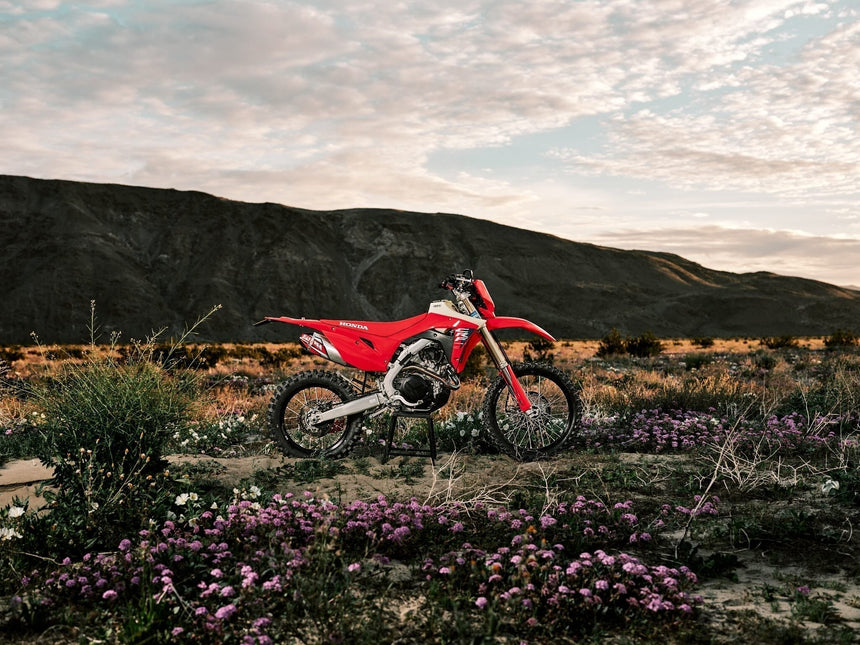
I remember the first time I saw the now-classic Baja race film Dust To Glory. My brother and I were at a poker run, sometime shortly after the movie came out, in the Blue Mountains of Eastern Oregon. We were roughly 19 and 20 years old, my brother riding a 1993 KX250, and I riding a 1987 CR250. After watching Dust To Glory on DVD in my uncle’s camper at the event site, we spent the following day on a gravel road, on the throttle stops racing semi trucks parallel to us on Highway 84. The infectious energy of Dust To Glory was thumping through our brains while we pinned our two strokes and fishtailed in the loose gravel at wide open throttle.
 Born too late to work in this era of marketing. Photo courtesy of the Internet.
The energy of that film still hasn’t left my mind. The Honda 1x A-team and 11x B-team racing each other on the Pacific coastline, with the Honda helicopter as a witness, remains one of the most memorable dirt-racing moments seared into the movie projector behind my eyeballs. Almost a larger character than Johnny Campbell, Steve Hengeveld, and Mouse McCoy was the legendary Honda XR650R. The BRP is a bike that ranks highly in the “greatest of all time” thumper list and commands deep respect to this day, two decades after its production. It still has a devoted following—as recently as late last year, Dakar racer Skyler Howes built a faithful Baja XR650R replica that has many attentive details.
 Skyler Howes doing Skyler Howes things. Photo via Skyler on Facebook.
The XR650R held a mythical might for me. It might be the GOAT. That said, its follow-up, the CRF450X, is also on my list of all-time favorite bikes. I’ve owned two of them that I’ve dual-sported and used for Baja pre-running, and I’ve been fortunate to race a few of the Gen 1 / Gen 2 450X bikes, as well. The carbureted 5-speed 450 is powerful, reliable, easy to maintain, and offers many thoughtful mechanical design elements from the engineers. This appreciation for the Gen 1 / 2 450X made me curious about the redesigned Honda CRF thumpers, with the Gen 3 bikes updated to a modernized throttle-body fuel-injected motor and 6-speed gearbox. I picked up a 2026 450RL, with the intent to build it into a dual-sport inspired by the Baja-dominating CRF450X pre-runners and race bikes.

I did a review of this bike on Mosko’s YouTube channel last fall at the Dusty Lizard in Clayton, Idaho. Overall, the bike is fine in its stock configuration. “Fine” isn't particularly inspiring, but it’ll do for most riders. I rode it on doubletrack and single track in Idaho, and if I weren’t so inspired by loud, barking, snarling Honda race bikes, I’d be inclined to leave the bike mostly stock, and probably would enjoy dual-sporting it in most riding conditions. It’s not the wildest bike, but it’s a consistent, reliable bike built on a proven design.
 But farkling-out bikes is fun, right?
Starting with the motor, I replaced the stock RL cam with a San Diego Powerhouse cam kit that’s based on the 450RX cam profile. The kit includes the cam, necessary valve and valvetrain parts, and the required gaskets. It’s a pretty well-made kit, but it’s a bit more advanced for those who might not be confident opening their motor. SDPH claims about 57 horsepower when paired with an aftermarket exhaust and a tuned ECU. I opted to add a Yosimura RS-4 exhaust, including header and muffler, and the homies at Taco Moto sent a tuned Athena GET ECU to complete the package and unleash the motor's full power potential.
 I emailed Bobby at San Diego Powerhouse to discuss the advantages of deleting the stock thermostat housing and some associated hoses. Usually, I’m not one to delete thermostats, except for hard-enduro or other prolonged, harsh use cases. This is especially something I avoid on fuel-injected bikes. FI motors rely heavily on coolant temperature to set the fuel and achieve optimal combustion and performance. Most people associate thermostat deletes with cooling motor temps; however, thermostats are also about raising motor temps to the correct operating temperatures that maximize combustion efficiency and motor performance. I went back and forth on whether it was worth deleting the thermostat, and ultimately went for it, as the thermostat delete kit also deletes the PAIR valve, charcoal canister, and valve cover breather oil catch can. These emissions items add complexity to the motor; they were especially noticeable to me after working for many years on the Gen 1 / 2 450X motor, which is devoid of them. The motor looks a lot better and will be easier to field-repair with them removed. The SDPH kit includes the necessary wiring plugs to delete the charcoal canister and PAIR valve sensors, avoiding potential check engine lights or performance problems.
 I picked up a bunch of Source Offroad parts for the build. Initially, I reached out to get one of their CRF450X rear fender swap kits–which I highly recommend for its tail-tidying simplification and racier styling. I also ended up getting their clutch kill and sidestand kill delete plugs, a TST adjustable blinker relay, low-profile front and rear blinkers, and a slim left-side bar switch. Source Offroad’s parts are super clean and professionally built, with plug-and-play wiring that mates into the stock 450RL harness. It’s my first time seeing their parts, and I’m impressed by them and highly recommend their accessories for the RL.
 It’s nice to see some of the racier Honda 450s, like the 450R, finally getting a hydraulic clutch. The cable-actuated clutch on the Gen 1 / 2 450X was always fine, for what it was. Dual sporting and desert riding were fine, but I wouldn’t want to ride tech stuff all day with it. The 450RL maintains the cable clutch from the Gen 1 / 2 bikes, and the stock clutch feel was okay, but the lever wasn’t very impressive. I picked up a 2-finger lever from Righteous Stunt Metal, known for Harley-Davidson stunt-riding parts. It gives the clutch incredibly smooth, easy 2-finger actuation.
Based on some reading about the stock clutch pack, I also opted to delete the judder spring in the clutch center hub by taking the spring out and swapping the thin judder spring fiber disc for a standard fiber disc. It’s a straightforward procedure that can be done in a few minutes for $18 in parts and avoids potentially breaking the thin judder spring fiber disc under the added power the motor is making.
 I’m a big fan of Showa suspension. The Showa on the 450RL is pretty similar to the Gen 1 450X suspension, though the fork tube diameter increased from 47 mm to 49 mm in the generation change. I didn’t have any complaints about the stock suspension valving for dual-sporting, so I just added Race Tech springs rated for my 225 lb build and modified a 2022 450R X-Trig shock adjuster for the rear shock. The X-Trig ended up being a bit of an ordeal to mount—I’d not recommend modifying the 450R X-Trig unless you absolutely need one on your bike. X-Trig, if you’re reading this: please make a stock 450RL adjuster!
 My former Baja 1000 teammate Robert Smith, who owns Desert Unlimited in Lake Havasu, AZ, was kind enough to send one of his clean, custom, plug-and-play Baja Designs XL80 headlights. There’s honestly not much I can say about this Desert Unlimited light that lends to their reputation; Desert Unlimited lights are on the bikes of teams winning the SCORE desert series, including the SLR Honda 1x bike. This kit takes the Baja Designs XL80 and adapts it for the 450RL headlight mask, maintaining the adjustability of the beam and high/low switching, running off the stock 140W stator. The spot/flood combo beam delivers a whopping 9,500 lumens on high and an innocuous and DOT-safe 1,900 lumens on low.
 Kirk Slack replacing a Gen 1 450X swingarm on the side of Highway 5 at 4:30 am. Photo by Dave Coy.
The Achilles heel of the Gen 1 / 2 450X chassis—the light, low-penetration chain guide TIG welds on the swingarm—unfortunately was not improved when Honda redesigned the platform for the Gen 3 bikes. While I have plenty of praise for the Honda 450, one of the few things I can’t understand is the chain guide mount—how this passed inspection on the way out of the factory is beyond me. During the 2020 Baja 1000, one of the riders on my Pro Moto 30 team hit a toaster-sized rock in Matomi Wash, ripping the chain guide off the swingarm and bending the rear sprocket. It took our team the better part of the night to get the bike out of Matomi so we could replace the swingarm with one from a pre-runner. That was a mistake learned the hard way; since then, my friend Tony, a professional TIG welder and the owner of Tonic Bicycles in Portland, has upgraded the chain guide mounts on my Hondas. The upgrade to the mount adds gusseting and deeper, thicker welds, preventing this potential failure. If you don’t know a pro TIG welder that can do aluminum, you can always ship your swingarm to San Diego Powerhouse, or Colton Udall at Champion Adventures in So-Cal. They both offer the chainguide mount service.
With the upgraded chain guide mount, I added a TM Design Works chain guide and re-geared the rear sprocket down two teeth with a JT Steel sprocket. Lots of riders run aluminum rear sprockets; I like a steel sprocket that sacrifices light weight for more survivability against rock impacts. I also replaced the stock plastic case saver with a clean, aluminum one from Zeta Racing, and swapped the stock chain for a DID 520 EVRT x-ring chain.
 One of my least favorite features of the stock 450RL is the low-capacity titanium fuel tank. The IMS 3.0L tank gives the bike usable dual-sport range, and I added a Hunt Racing low-profile, threaded dry-break gas cap for a race-y look that also makes it easier to mount a small tank bag like the Nomini.
 IMS Core Enduro foot pegs, a Fastway System 3 steering stabilizer, Scotts frame collar (note: as of press time, I did not have the stabilizer installed), and SX Slideplate handguards complete the build.
 For tires, I run the Baja-tried-and-true Dunlop D606 rear, and a Shinko 216MX front tire, both with Nitromousse. The D606 is not flashy, lacks cool-looking siping or tread block patterns, and probably has an old, less innovative rubber compound; but, it’s a simple, effective tire with excellent wear life and good performance on dual-sport and desert trips. The 216MX pairs nicely as an all-around dual-sport-friendly tire that performs well on and off road.
 The bike rides really well with the mods, and looks much cleaner and more race-like with the various cosmetic changes. It's ready to go on any Baja mission and would be at home pre-running for a SCORE race.
Kris Regentin, Marketing Director, Mosko Moto
All photos shot by Drew Martin unless otherwise noted


Comments will be approved before showing up.







Benjamin Sypher
October 01, 2026
I am also setting up 2 450rl bikes for adventure riding. Would you please share how to mount the Gnoblin? I could fab something up, but I would sincerely appreciate seeing how you solved this.
———
Mosko Moto replied:
Hey Benjamin! We have a video in the works detailing how we did this. Stay tuned and we’ll get it posted to YouTube soon!